
Before & After
A conversation with Laxmi Hussain and Louise Lockhart

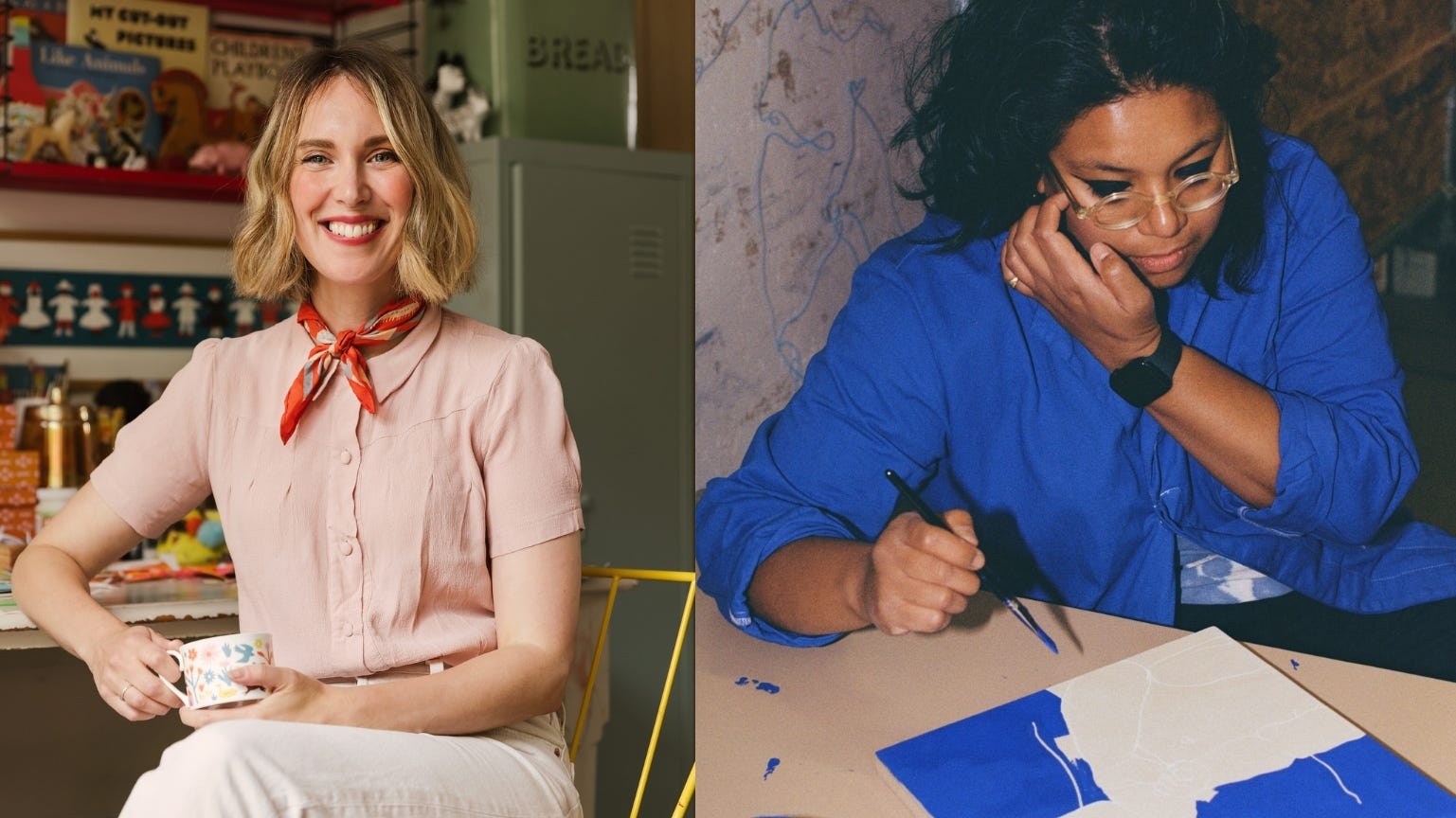
This is an edited transcript of the first Elastic Orbits conversation, held online on 21 May 2026. It has been condensed and lightly edited for readability.
This conversation is dedicated to a dear friend I lost to postpartum depression. She was my sparring partner when we decided to become independent designers — and this is exactly the space she would have shared with me. This one is for her.
— Sarmishta
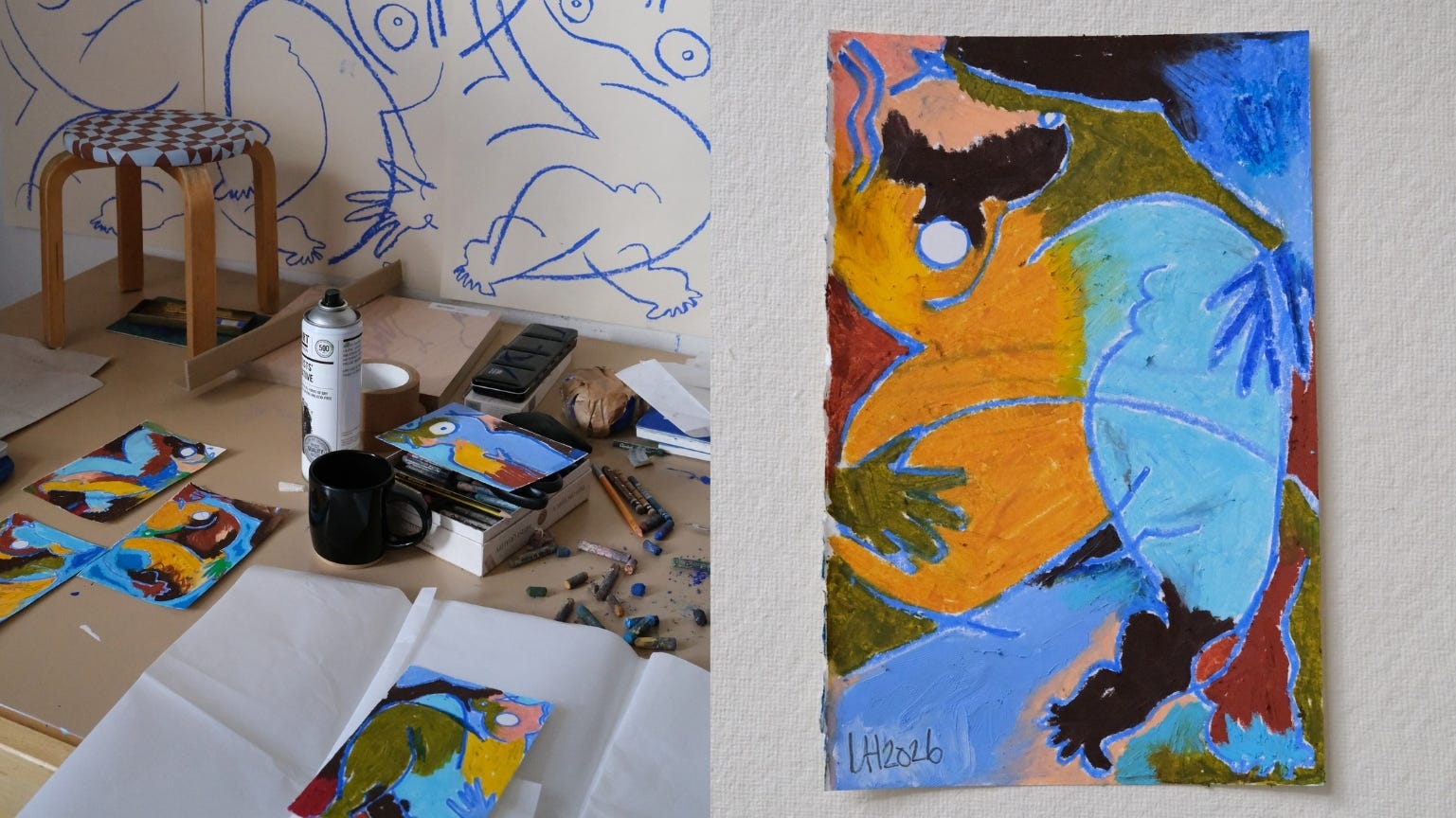
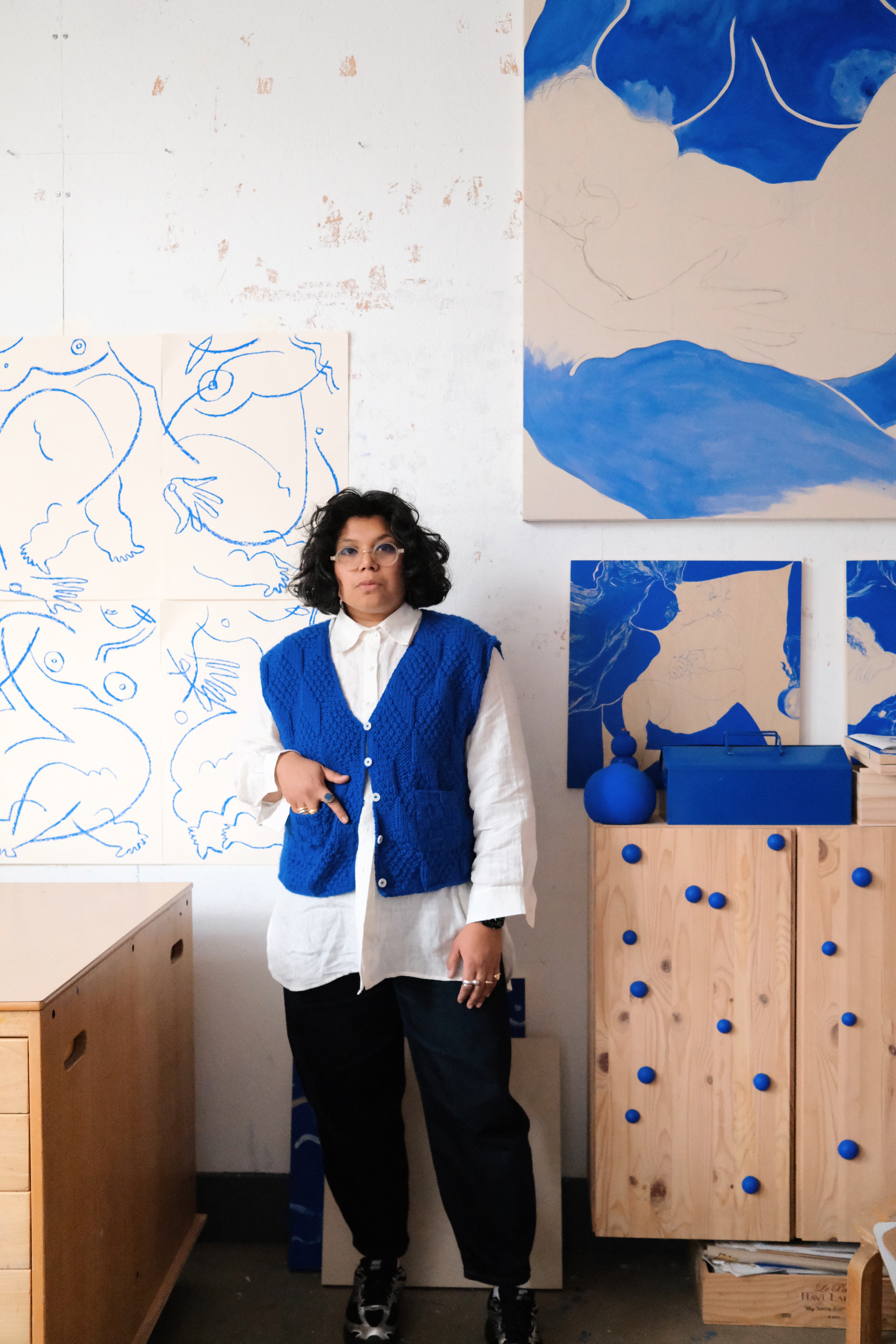
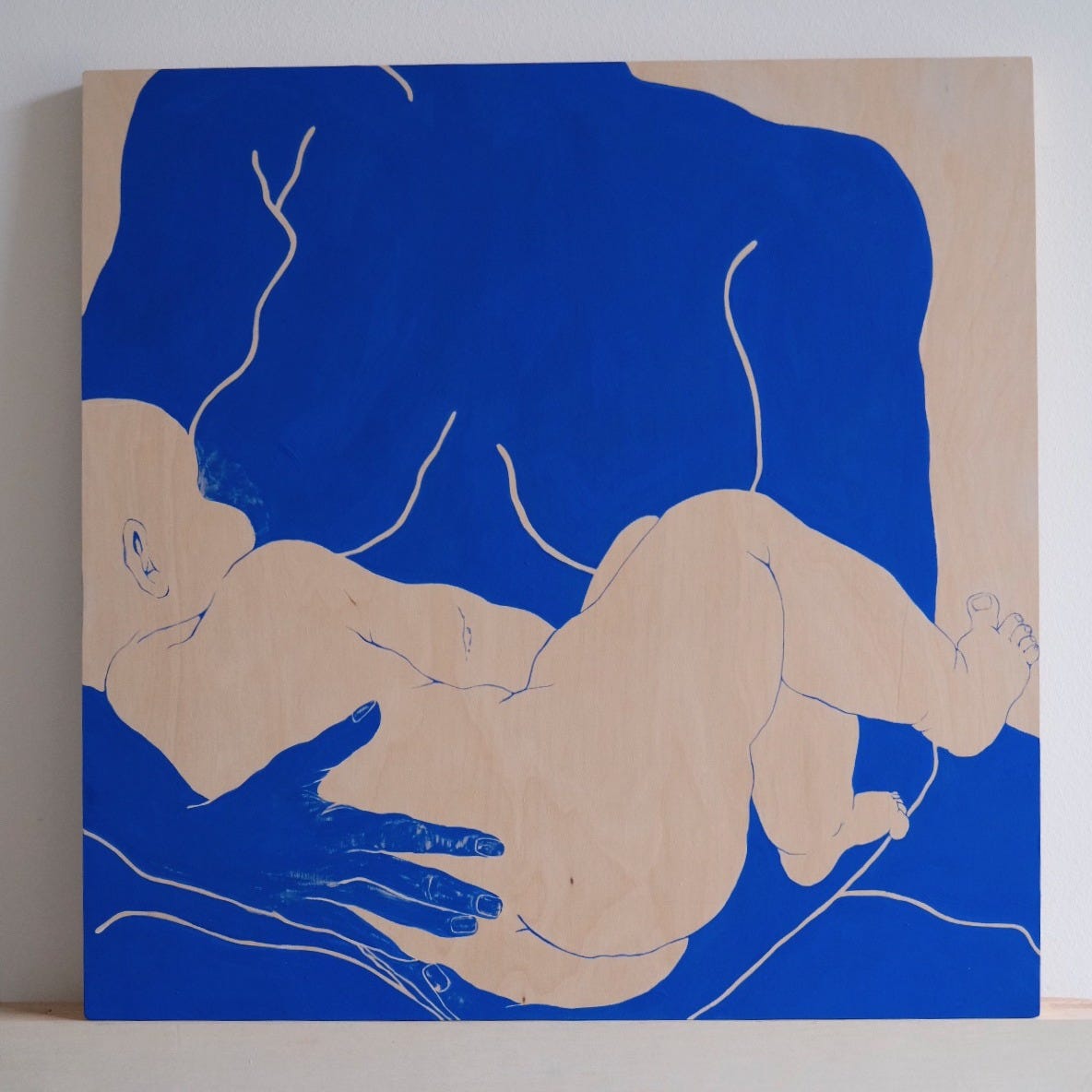
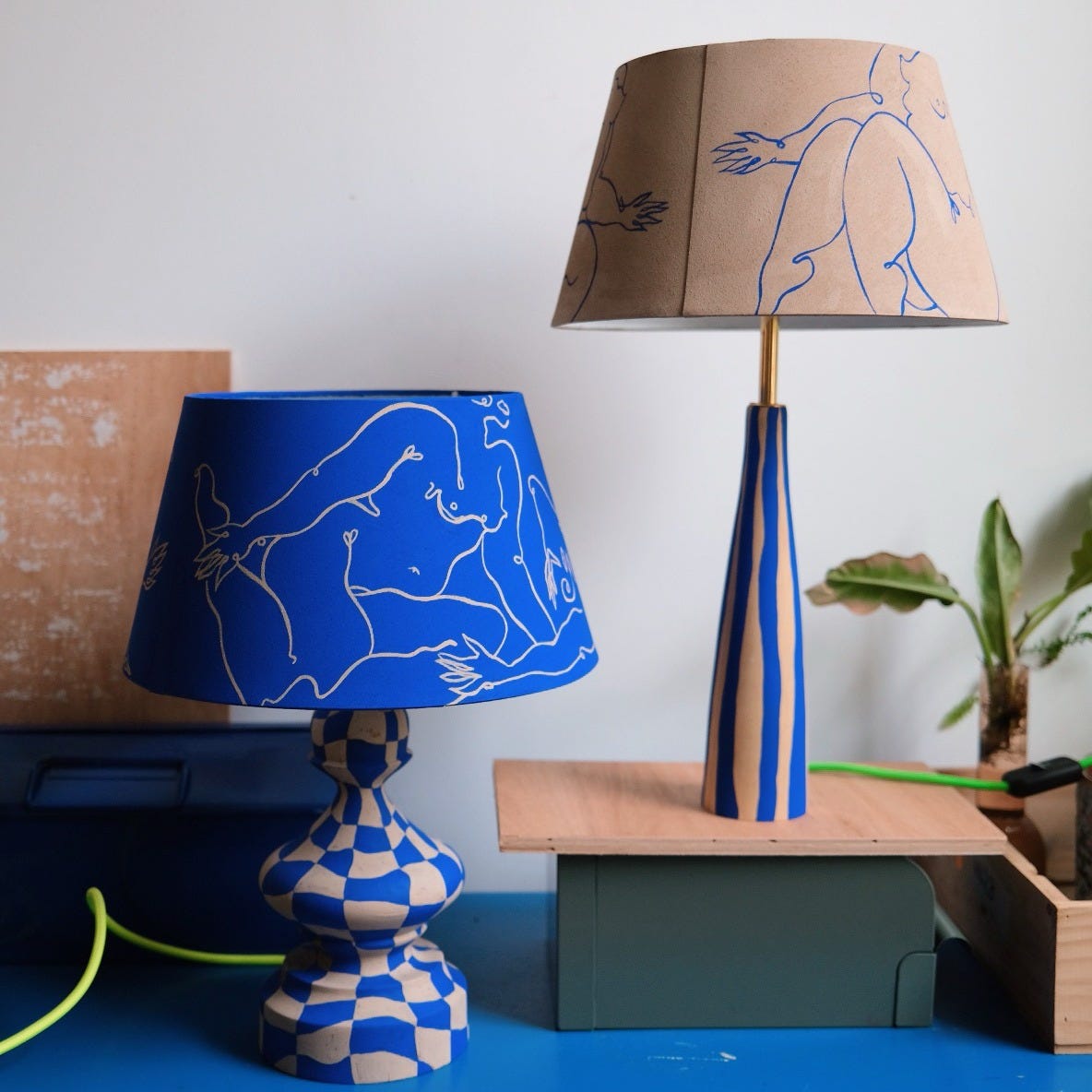
Laxmi Hussain is a London-based artist. Her work is breathtaking — it is about the transformation of the female body, and she works with her signature blue, which is striking and carries deep personal meaning. She honours her own mother through the work that she does. What moves me about Laxmi is the fact that she only became a practising artist after becoming a mother — not despite it, but because of it. I’m fascinated to learn more about that. Her practice was born from the very thing we’re about to talk about.
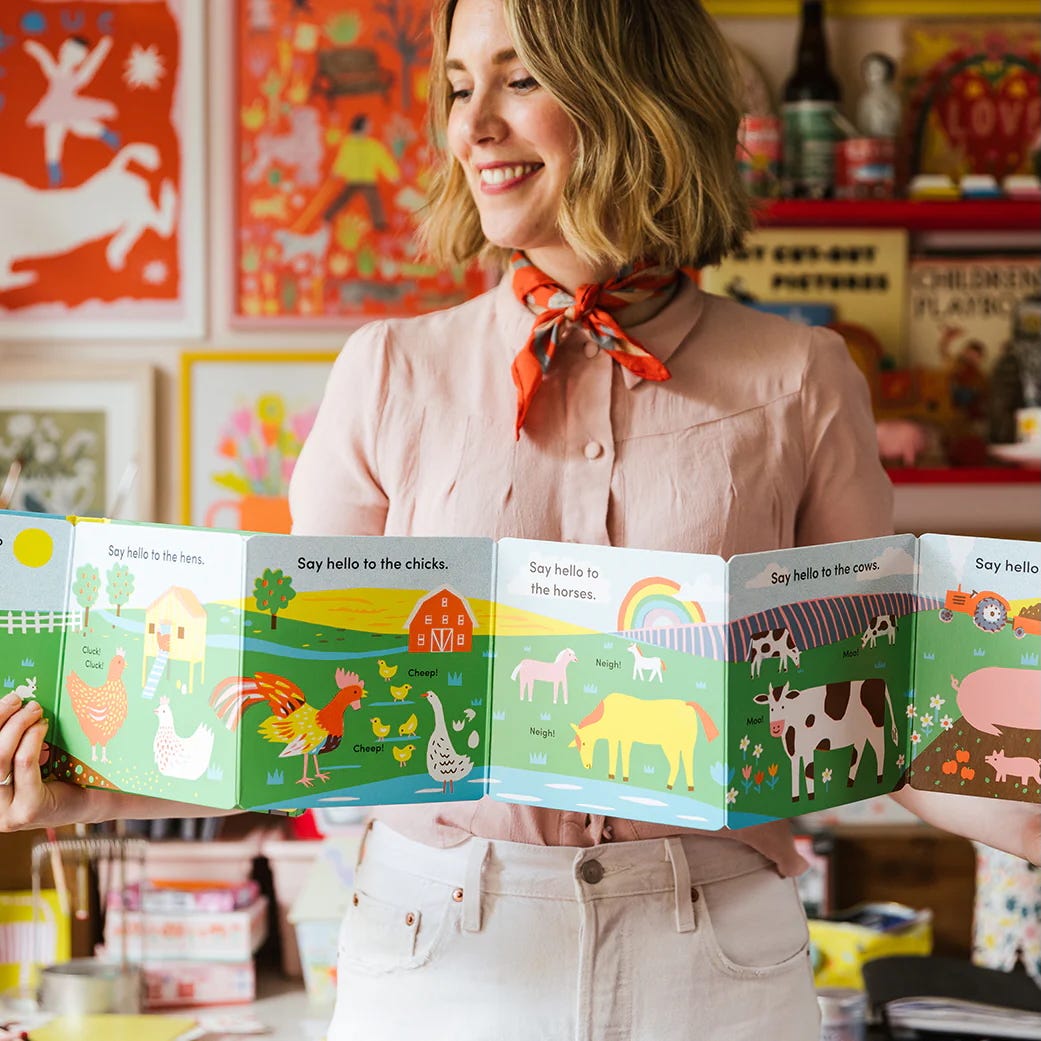
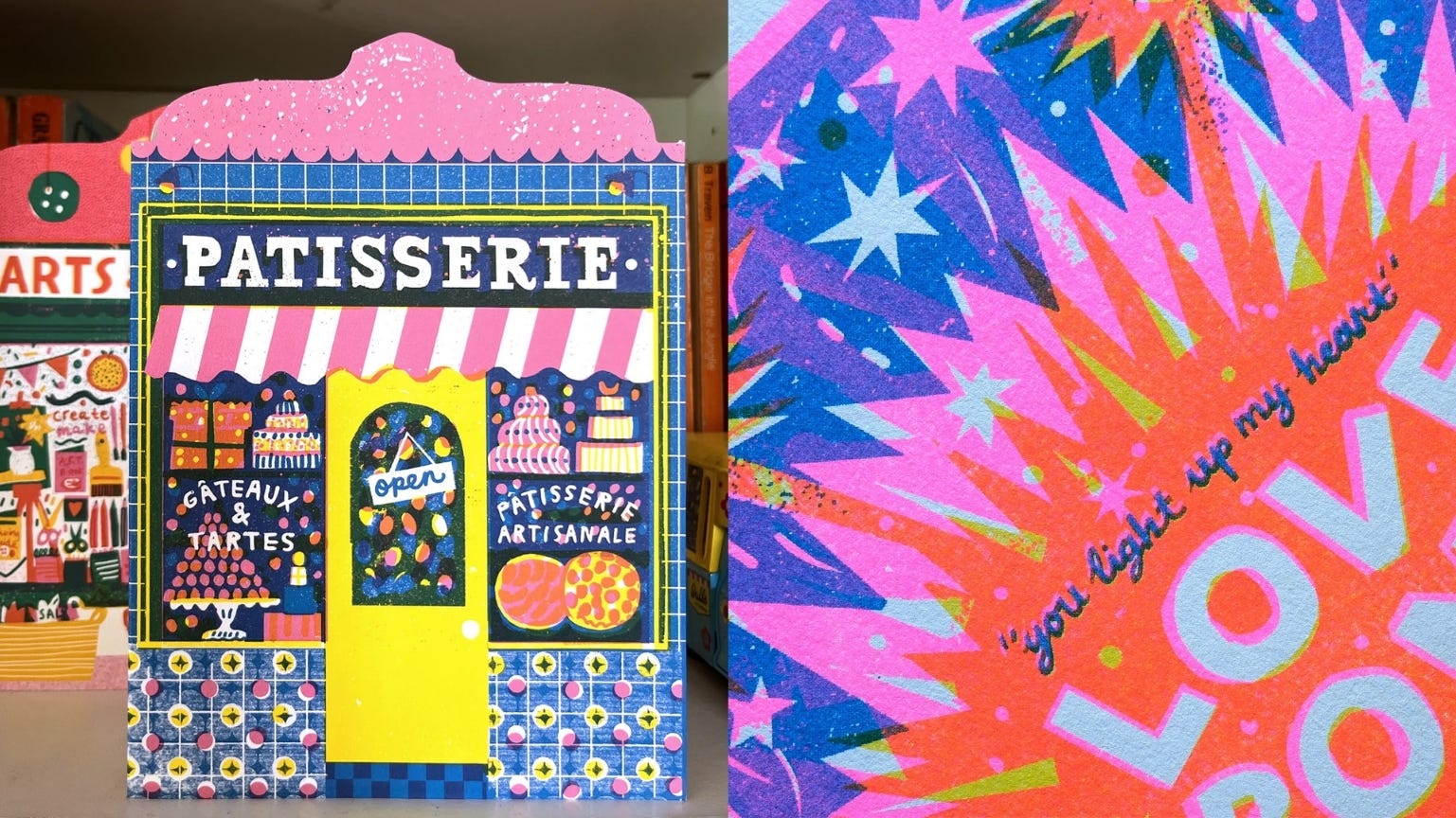
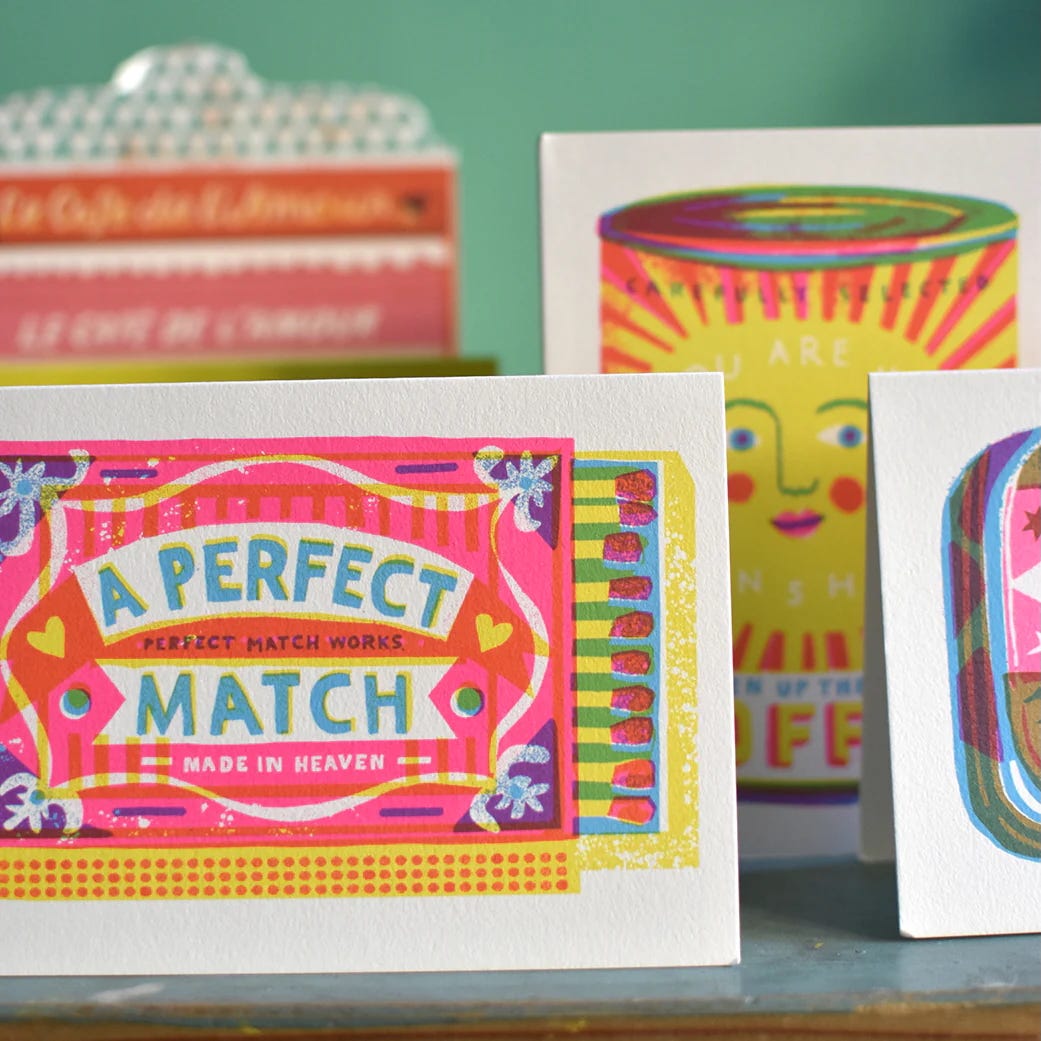
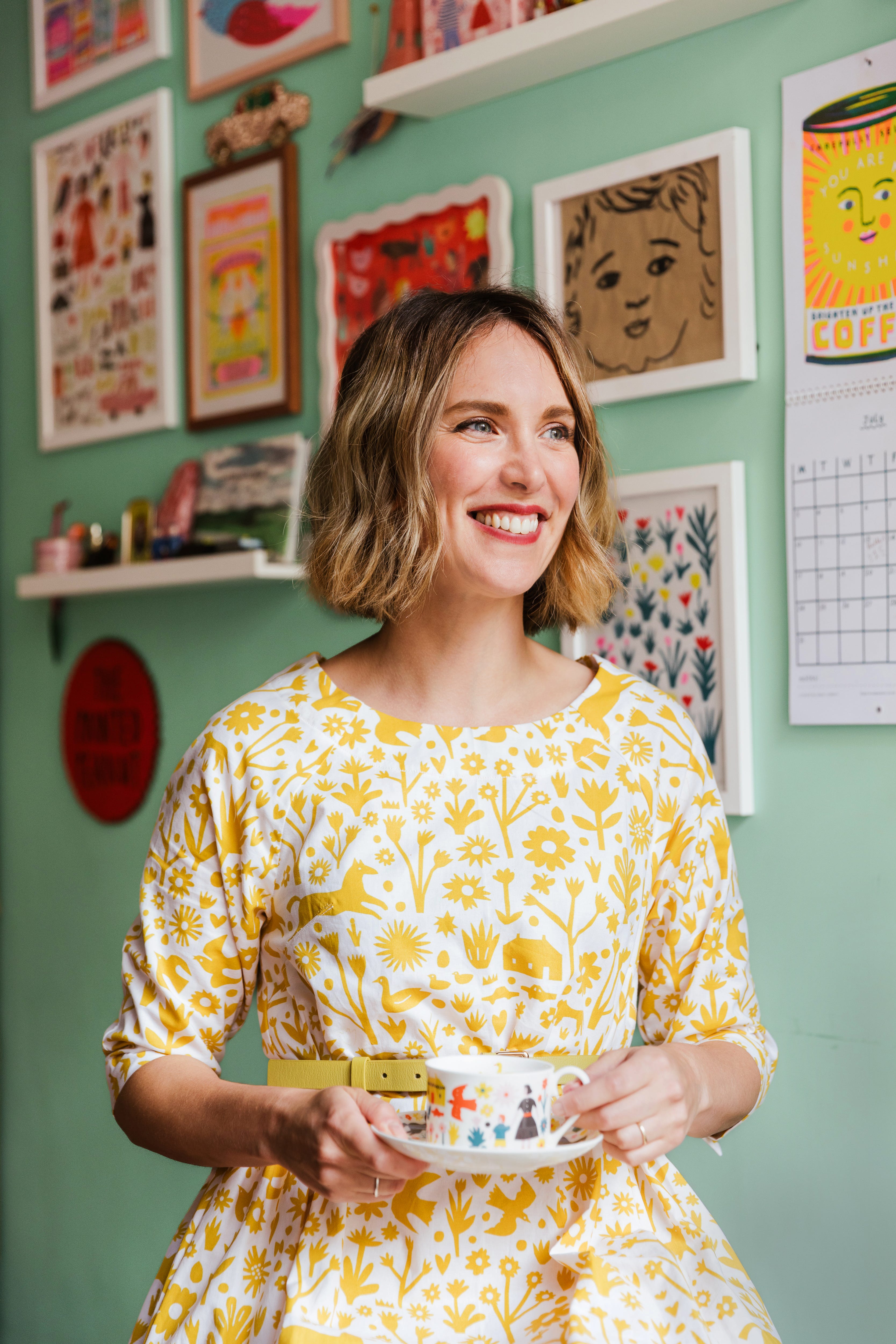
Louise Lockhart is the illustrator behind The Printed Peanut. Her joyful products — greeting cards, riso prints, clothing, books — make me feel happy when I look at them. That joy is very much Louise’s intent and source of inspiration. Louise launched her practice while she was in Canada, long before motherhood came along, and she’s held onto it on her own terms ever since. Hers is a story of independent creative spirit and the determination to protect what she’s built.
The two of them together — completely different standpoints for dealing with the same question. I cannot wait for you to hear them speak.
We’ll spend the first part of our time in moderated conversation and after that, I want to open the room for a Q&A. Please take notes, have your questions ready.
The Working Day
To start off — could you take us into an ordinary day? What does it actually look like? And how has it changed since motherhood?
LAXMI: Good morning, everyone. Thank you so much for joining us, and thank you, Sarmishta, for having me.
A typical day: I have three children — about to be 6, about to be 13, and about to be 16. The older two are pretty much very easygoing, they’re up to their own things now. It’s kind of this bizarre world where they start to move apart from you. There are still really tender moments in that, but they’re very much independent now. My 6-year-old is still very dependent, so he’s the one I take to school in the morning.
A typical day is dropping him off and coming here. I think as artists, because we work a lot in isolation, I try to then put in my own structure, so I usually go to the gym first for a couple of hours, and then start around 10. And that can be anything starting from admin, just kind of clearing my space, and then moving on to whatever I’ve got going on. So painting mostly. I’ve got a lot of print collaborations that I work on, and usually start the drawing process here and then just take my day through that. Occasionally, I do some sort of photography. I’ve spent a lot of time photographing collaborations with brands that I sometimes work with. I’m really, really lucky — to be tired of the thing that I love is quite a privilege. It can be a really different day every single day, and that’s what I love about my job. And then I usually finish up here about 5–6 PM and head home. If it’s my turn to make dinner, I might leave a bit earlier. And then tap into my other job, to be a mum.
LOUISE: It must be so good having a totally separate space to do your work, because I’ve always worked from home, and I think since having kids, that boundary blurs so much. They don’t honour this space as mine. But yeah, I do the same: get the kids ready. I mean, they get me up at 6 AM, which I wish they didn’t, but that’s when I get up. And then we have quite a long drive to school, because I live in rural Wales, so it’s an hour-long round trip to school every day, twice a day. I share that with my husband; he does the morning, I do the pickup. So he takes them in the morning from half eight, and then that’s my time from half eight, where I just try and do a bit of exercise. I’m not very good at that, but I might go on a walk or something. And then have breakfast, and by the time I’ve done all the boring admin, I’m working by about 10 AM. And then I have to pick them up at 3 PM, so I get 10 AM till 3 PM — which, thinking about pre-kids, I’d just get up and work from 8 till 8, whereas now it’s a much shorter working day. But I do sometimes think, if I didn’t have kids, I probably wouldn’t be working in that intense way that I did when I was 25 anyway. I don’t know, the kids have kind of stopped my working day from being so long, but maybe it wouldn’t have been anyway if I didn’t have kids. They take over from 3 o’clock. And then they go to bed at about 7. I keep reading about all these mothers that can work when the kids go to bed, but I’m just absolutely knackered by the time I’ve put them to bed, and it’s half 8. I’m out. I’m not an evening person, I’d rather work in the morning.
So I’ve got a very short working day. I love that every day is different, and I think that’s kind of the appeal of being a creative person, and you’re probably, by nature, not wanting to do the same thing every day.
To be tired of the thing that I love is quite a privilege.
Laxmi Hussain
What You Keep, What You Let Go
You said you could work 8am till 8pm, and now you have these five hours. Laxmi, you were talking about having a different schedule as well. So what did you have to keep, and what did you have to let go of, since this transition?
LAXMI: The key thing about becoming a mum is this adaptability. Whether you do it well or you don’t, you’re constantly adapting. I took on this studio when my youngest was 3 months old. I couldn’t afford it at the time — I even asked them to lower the rent so I could get on my feet, and they were really gracious and helped me with that for the first three months. As a patron might, for example. That meant I could see what my schedule was going to be like. I would bring the baby in here. When Eden basically spent his first three years of life here, I don’t know how I got anything done. We’d start, we’d load up with food for the day, we’d get here, go for a big run around Wembley Park with his bike or to the playground, and we probably wouldn’t get here until 10 o’clock. And then it would be work for an hour before he’d ask for a snack. I probably had two or three hours in that whole working day.
But your practice adapts, you adapt, and I think that’s very indicative of what motherhood is. Now I’m here by myself, and sometimes I sit in the chair for an hour and I’m like — I should be more productive, but you need that, don’t you? You need that for your own sanity.
LOUISE: Yeah. I think the biggest thing is that you just never even get to the end of a thought. You can’t just zone in and think about what you need to do — there’s always another need. And whether that’s us working from home, doing the washing, doing the lunches, whatever, see, it’s happening to me now. Your concentration splits. I’m the only one earning money in my family at the moment, so I’ve got to work, but the childcare is still equal between us. He’s working as well, but just not earning, but that’s just a lot, isn’t it? It’s a lot to take on.
LAXMI: I work with a lot of smaller brands who send me clothes to photograph in my studio. It’s a kind of trade rather than a monetary exchange. And there’s also a big brand who highlights women artists because they feel women artists are less represented. They sent me an outfit for photography, and because we’ve had no sun, I couldn’t get the shot. It kind of catapulted, so the rest of my day felt like I was behind. And then I got home, and I was in tears, because I felt like I hadn’t achieved everything I needed to achieve, and that’s the thing, it’s that constant pressure of trying to balance all of these plates.
LOUISE: Oh, it’s a lot, and I think we all know it well. I think we all support each other. I’ve worked on children’s books before having children and since having children, and it used to be that I could just fire one out, you know, in a few months, whereas now, the publishers still think I’m on that schedule, even though my eldest is 7 now. It’s just gonna take me ages now. I can only do it a little bit at a time. But they understand, because they’ve got kids, and if you’ve got a good working relationship, people try to accommodate.
Has there been any way you’ve either made that work to your advantage? And if you’ve not, then have you made peace? How do you work this out?
LOUISE: I think, for me, life’s more interesting. I wouldn’t be happy just sat at my computer working 8 hours a day with no other dimension to my life. I need more of a 3D life, and I think for me, having kids gives another dimension to it. I don’t feel like, oh, it’s taking away from my work. Life’s more complex than just work. I’m lucky that I had set it up before I had kids, so I could try and keep it going, which was really hard at first. And I felt like I didn’t know how to do it, but you just have to — like you say, adaptability — you try different ways of trying to make it work, and cut back on things that aren’t working. And for me, the main thing’s been prioritizing. My priorities have completely shifted since I’ve had kids. They’re the priority, not maybe what was my priority before, so that’s the main thing that’s spurred me on to make changes. I sell stuff online and sell stuff wholesale to shops. Before, I’d spend maybe 2 days a week packing up boxes of stuff to post out, and literally going to the post office with a little trolley, and waiting in the line — and that’s gotta go. I can’t spend two days of my week doing that anymore. So since having my second child, I thought to myself, right, I’ve got to prioritize what’s worth my time, and I’ve now got a warehouse to ship out my orders, which costs more money than me doing it, but I’d rather have my time than do that. I think that’s been a good thing.
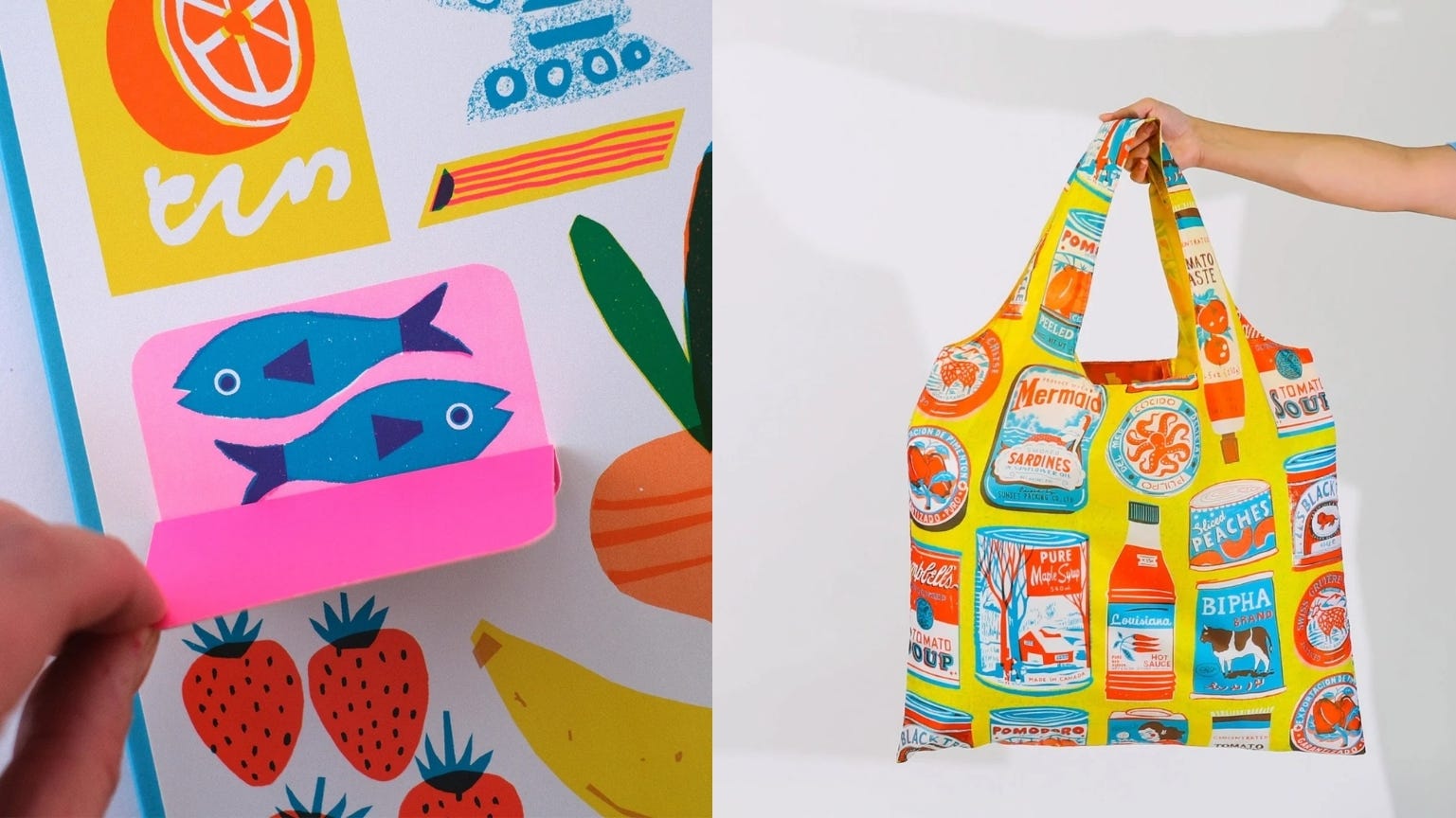
I've now got a warehouse to ship out my orders. It costs more than me doing it myself — but I'd rather have my time.
Louise Lockhart
LAXMI: I feel the same, and I think how it’s changed my work is in the drawing aspect. I’ve drawn my entire life, it’s always been a big part of my life. But I’m now able to draw really fast in a short amount of time. But like Louise, now that I’m older, it takes me so much time to paint, for example, but that’s my real passion. I love to paint. I was working towards a show recently. I think I just misunderstood how long it actually takes now, because I thought I could blow these out in a week. And so 3 weeks later, I’m still working on them. For me, it is my peace of mind — I want to be home at a certain time. I want to sometimes just organise my day like a business would, saying, I’m here from 9 to 5, and, you know, it might go over half an hour, but that’s got to be the cutoff, and that’s how I’ve adapted in that way.
LOUISE: And weekends as well. It used to be that I’d get emails on a weekend and I’d be replying, whereas now I just think, actually, no, I’m not going to do that. I do it in work hours
.
The Leap
Laxmi, I’m curious, because you said the whole thing started after having kids– what was required of you to actually make that leap? There’s plenty of us who, after motherhood comes along, change priorities and maybe want a different career — but that takes work. To make that leap– what was that like for you?
LAXMI: So just a bit of background: my degree is in architecture, so I’ve always drawn and been in the creative space. I did my art GCSEs; I did art at A-level. The norm was that, because both my parents come from an immigrant perspective, and particularly my mum comes from a very, very poor background, my mum came here to escape that and worked her whole life in order for us to have a better life than we would have had if we were in the Philippines. Her expectation of us was that we would all get professional careers, so that we would never have to understand what that was like. In hindsight, it was never going to be possible, because we have such a large family, and obviously, we would always experience that whenever we visit them. But she wanted there to be a more positive future, and to start with her family.
So that’s why I went into architecture, because I thought I could still draw, but it would be a profession, but I hated it. And it was really sexist. I graduated a long, long time ago, but I couldn’t get jobs, and all my male peers, even the ones with lower grades than me, were all inexperienced, and I just couldn’t get a job. So I just fell into an office job, and it was when I had my eldest that I started drawing again. And I would draw on my lunch break at work, and people started wondering what I was doing. At first, I was making cards, because that’s kind of what I did all of my childhood. Whenever it was a birthday or an occasion, I would make someone a card. And so I was making cards at the time, and one of the members of staff said, why don’t you put on a little greeting card session after work one day? And we’ll buy them. And so I did, and I sold them all. I didn’t think anything of that, I just thought it was nice to have a bit of extra cash, and then, because we were quite a large office, people would ask me if I had any every now and then. And I just started making more and more, and one led to a commission, and then led to a logo design, and so I was a bit more design-based. And then when I had my daughter, I realised I was doing this a lot more than I thought I was, and at first it was just sort of a dream hobby situation. Then I thought, but what if it could actually be a job? Or I could do it for half of my income? And when you start thinking those things, it’s like an itch you have to scratch, right?
And then when I had my youngest, I had the opportunity of being in lockdown. And because I couldn’t go back to work, I thought, well, let me see how it goes. And when they asked me to come back to work, I said, I think I have to give this a go. And that’s pretty much it. I haven’t looked back, and I’m really grateful for such a great audience on Instagram who purchase my work, who I wouldn’t be here without.
When you start thinking — what if this could actually be a job — it's like an itch you have to scratch.
Laxmi Hussain
LOUISE: I had my eldest in COVID as well, and just that whole slower pace of life gave us permission to prioritize art in a different way than when you’re really busy and quick-paced, that priority just always slides to the bottom. I feel like we could have taken some lessons from that time.
LAXMI: I absolutely think so, and sometimes we have nostalgia for that slower part of life that we had whilst we were in lockdown, and especially, when we spent so much time with our kids.
LOUISE: Yeah. My son was one, and then it was lockdown, so it was the perfect age for me to be with him all the time. I mean, it must have been a nightmare for people that had to homeschool. A one-year-old’s alright. And I remember when I had him as well, my mum said, you’ll never be able to work again. He slept quite a lot, he loved napping, and then my mum said, this isn’t normal, you know, they don’t normally sleep this much. I thought I’d have no time to make art once I had a baby. I’d cleared the decks, but because he did nap, I started playing again and making art, like I had when I was a kid, without an audience in mind, without doing it for a card, or a product, or something like that. I just did it for me. And that ended up being such a foundation for my artwork, just remembering that this is what I used to do. This is what I did as a kid, this is why I do it, not just to pump out stuff to get likes on Instagram. To actually make it for my own self — that’s why you’re an artist, isn’t it? To make it for yourself, really. And then once you start doing that for money, you forget about that sometimes.
LAXMI: Absolutely.
That's why you're an artist, isn't it? To make it for yourself. And then once you start doing it for money, you forget about that sometimes.
Louise Lockhart
Guilt
LOUISE: You feel guilty about it. I feel like guilt’s a massive thing. I’m guilty if I’m not with my kids, and then I’m guilty if I’m not working. I need to get rid of that guilt cycle, I think. I don’t think men have it as much.
LAXMI: I definitely think they don’t. The thing that I feel really guilty about all the time is when I leave late, and when I’m talking about leaving late, the latest I am is half an hour. But for example, if I leave the studio to cook dinner at 6, and I leave at 5 o’clock, I know I’m only 15 minutes down the road, but if I forget that I’ve got to also buy the food to then cook. I’m already burning with anxiety. And then I get home, and everyone’s sitting on the sofa watching TV, like, hi, mum!
LOUISE: I have to remind myself that it’s good for them to see you doing your own thing, even if you’re not making money from that. A lot of kids have grown up thinking that’s not a viable thing to do. So I think it’s good to show them that it is.
LAXMI: Absolutely. My youngest thinks that everyone wakes up and goes to work in the studio. And I hope that he thinks that for a long time more.
LOUISE: I had a conversation with someone about this sort of thing the other day. I was saying I feel guilty about not working all the time, and she said, well, what were your parents like? Did you see them doing that? Did they never stop? And I thought, oh yeah, that’s probably where I’ve got that from, because they’re both artists, and they never had any money and were always working. I don’t want my kids to pick that up off me; I want them to see me stop working as well, because I don’t want that cycle to continue where you feel like you’ve just got to work all the time. So it’s that balance of not working as well
I'm guilty if I'm not with my kids, and guilty if I'm not working.
Louise Lockhart
Money
I have a piece of text that I read that made me just sit up, that I want to read out now, which is very similar to what you’re talking about. It’s from Hettie Judah’s article, “Full, Messy, and Beautiful.”
“The guilt experienced by artist mothers is rooted in broader cultural issues. Art doesn’t come with a fixed wage or an established career trajectory. The making of it doesn’t have an easily quantifiable value. With childcare costly, how dare you spend money to work without guaranteed financial reward? How dare you take time for your work away from your children? How dare you bring children into the insecurity of an artist’s lifestyle? With guilt, too, comes concern that the artist will be considered a selfish mother. Mothers are meant to be selfless. How can they demand time and space for this work? Yet, if they do not, and continue to fit art into the demands of a family, they’re belittled as hobby artists.”
Our work technically never stops, because as independent people, we have to market it; there are a number of things that need to be done outside of the work itself. In a full-time job, you can make mistakes, research, experiment — and still receive a salary every single day. Once you become independent, it’s about output.
So, given that kind of pressure, how do you strike a balance between financial stability and allowing yourself the time for experimentation, for process, for the becoming?
LOUISE: So hard.
My youngest is nearly 4 and I’ve now got to the point where I feel like I can experiment a bit more again. But when they were little, I just did what I knew would be more stable, I suppose. So, that’s that sort of adaptability thing, but for me, selling my own products to other shops, that’s the thing that’s always been the steady income. And then all the illustration jobs, that’s very hard to predict when that’s gonna happen, so that’s very sporadic. So, hopefully they’ll come, but they’re not as reliable. So I put my effort into selling wholesale to shops, because I knew that that was my bread and butter money, and now the kids are a bit older, and I think, okay, now I’ll do an exhibition of my own work. I don’t know how that’s gonna go, but that’s been the risk, I suppose, but I waited till they’re a bit older.
LAXMI: I think, for me, I could really relate when, Louise, you said that you have to work for financial reasons, because for a long time, I was the main breadwinner. And it’s such a hard thing when you’re in a career that is so unstable. A lot of the time, I am governed by my heart. I’ll think: this is what I want to do, and I’ll figure out how to make money afterwards.
Drawing is an everyday part of my life. And whether it’s going out there in the world, or it’s just for me, it always has to be a part of my practice, and without that, I lose the lustre for anything else. And I figure out the rest afterwards, and hope that it all works.
This is also why I’m so hard-headed about wanting to share motherhood in my work, because, like Hettie said, about how motherhood is taken less seriously. I think that being a mother and an artist combined, and then sharing that extra layer of motherhood in your work, makes me feel a bit rebellious in that way. We see the glorified Madonna and child in art, but we don’t see the likes of Chantal Joffe and Louise Bourgeois — we don’t see that as often. We can name a few artists in handfuls that depict motherhood, and for me, it felt like such a fleeting but difficult time with lots of these incredible layers.
For me, there is this personal connection — the blue represents my late mum. And when I started to actually paint my version of motherhood, I thought, this is a really bizarre nostalgia, because I remember the way that my mum would be with us. It’s just my kind of rebellion, I guess, but I’m really lucky that there are lots of people who resonate with that message and want to feel seen in that way, and that’s always what’s helped me propel my work forward.
But yeah, it’s hard, isn’t it? It’s hard to make those decisions, be the decision maker, be the business, be the arm of social media, be the financial side. All of those things combined is what we think makes a successful artist. But it’s hard to be all of those things.
I think that being a mother and an artist combined, and then sharing that extra layer of motherhood in my work, makes me feel a bit rebellious.
Laxmi Hussain
LOUISE: Following your instincts and your heart, like you were saying — because sometimes you get onto a winning streak with something, and you think, oh, well, I know this is a guaranteed moneymaker, but then your heart starts shrivelling up, because you’re thinking, I don’t want to be doing this anymore. You want to evolve, but even if that seems like a silly decision, to stop making the thing that you know is going to make money, you’ve got to stay true to yourself as well, so that’s really hard.
LAXMI: Yeah. When you relinquished your packing element at home, I can imagine how hard a decision that must have been, because in our heads, we’re thinking, oh, I can do it myself. I love to teach, and I do a lot of workshops, events during the summer that are workshop-based, around life drawing and teaching that anyone can draw — because I truly believe that. And I truly, truly believe that drawing as an activity, as a tool, is so great for mental well-being. And I used to do an art subscription box, which was every two months. And I gave that up in lockdown because to create the box, to pack the box — and even though it was very much who I am and what I love to share, and it was a big part of my income that I was relinquishing — I just couldn’t. It was just so hard to do it. It took up so much time, and I cared so much. The box was such great value for money, but it was just such a huge mental load that I had to give up. But unfortunately, sometimes you have to just follow your instincts, don’t you?
LOUISE: Yeah, you don’t want to be a factory. That can happen. My sister-in-law makes egg cups, and she got onto a winning streak with these handmade ceramic egg cups for the National Portrait Gallery, doing David Bowie and Frida Kahlo and things like that. Then she became this factory, just churning out all these handmade egg cups, and she’s lost the joy of why she did it in the first place.
My mum’s an artist, but she had her first child when she was only 22, and got into teaching, because that’s what her parents had done, and when I left art school, she said, teaching is a really good way of doing art, but having a more steady wage. But I just knew that I didn’t want to do teaching, and I thought, if I get one teaching job, I’ll be funneled into that then, and you get more and more of whatever you put your energy into. Even though I know that that’s probably a good idea, I don’t want to do that. You have to kind of set your own path, otherwise you get kind of lumbered with more and more of the same.
LAXMI: Absolutely. That’s why I love that my teaching is event-based, because then people will make the effort to come; they know this will be a limited run. On Saturday, I did a free workshop. I’ve been working with Windsor & Newton, who put on a free workshop this weekend, and I got so many messages saying, will this be repeated? And in my mind, I’m thinking, it’s such a good way to make money. But you can’t.
LOUISE: But that adaptability thing, again — people are always looking for real-world experiences, so doing workshops and things is a brilliant way to connect with people, but it’s a lot of energy; you can’t do them every week.
LAXMI: Definitely.
LOUISE: Your energy is the thing that you protect, isn’t it? Because a lot of people say to me that they have a part-time job for the steady income, and they want to do their art as well, but they can’t give up the wage. I was in that position before I had kids, but I just had to give up the waitressing job, because all my energy was going into it. I didn’t have the energy to do creative things when I came home. And kids can be a bit like that as well. You have to kind of harness your energy, don’t you? And then just save it.
You have to kind of set your own path, otherwise you get kind of lumbered with more and more of the same.
Louise Lockhart
We’re talking about revising what you work on, and what you want to move away from, based on the amount of time you have, the age of your children, and your own intuition. Have you had any challenges with shifting how you present yourself to your audience, whether that’s Instagram, or your clients, or anybody else?
LAXMI: I had to kind of filter out the workshops I was doing, because I can’t survive on workshops. It’s just not financially viable. I’d have to be doing 10 times the amount of workshops compared to a couple of paintings, and that would just take me completely away, so it was a really slow shift, but I just had to do it. It’s just like Louise said, your instinct is to go for the things that you really want to do.
LOUISE: People always respond positively to that, because if you’re true to yourself, then people can sense that. I think they can sense it when you’re not; when you’re not true to yourself, the work sings in a different way, and then people respond to that. Sometimes I get messages saying, do you still do this print, and I haven’t done it for a while, and I just say, nope, sorry, but I don’t think people mind that much. I did sell quite a lot of soap, but it got to a point where I was just only selling the soap. It was overtaking all the other things that I wanted to do, so I just went, right, I’m not going to do the soap anymore. That’s such a stupid business decision, because that’s the thing that I was selling. But I just didn’t want to be known for soap. I wanted to be known for paper products and print and cards and stuff. So I just stopped the soap and built up my paper cards business much more, and now I’ve reintroduced the soaps back in, because I just wanted to be known as a print person. So even though that seems like a really stupid business decision, that was just what my heart was telling me to do.
LAXMI: I subscribe to Mr. Bingo’s newsletter. He’s an illustrator based here in London, and in one of his recent newsletters, he asked his audience to ask questions, and he would answer them. And one of them was, how do you decide what you’re going to put up for sale? How do you decide which one’s a winner and which one isn’t? And he basically said that he just does whatever he wants, because what he’s learned — even though he’s got a larger audience — is people love your work, but once they’ve flicked off of Instagram, they’re not thinking about you anymore. They don’t think about you when they’re going shopping, they don’t think about you, so just do what you want. And that was really great, because that’s essentially what artists need to think about — we’re not creating work for our audience, even though we’re really grateful for our audience. We’re creating work because we don’t know how to be any other way, and this is our story, and this is how it’s laid bare, and the greatest way to tell stories as a people is through the things that we make.
LOUISE: And your images are about motherhood. That’s the story of your art now.
We’re creating work because we don’t know how to be any other way, and this is our story, and this is how it’s laid bare, and the greatest way to tell stories as a people is through the things that we make.
Laxmi Hussain
The Work Itself
LAXMI: They’re about how the body adapts, and at the moment, a lot of it shares motherhood, because I’m deeply in the thick of it.
I don’t have my parents anymore. My mum died 8 years ago, and my dad too. And I’m also of dual heritage, and my children are doubly mixed. And so coming from dual heritage, there’s always this kind of identity crisis, because you don’t know which pocket you sit in. I also have the third element of being born in London, and very much identify as being a Londoner. Whilst I’m mixed Asian, my children have African heritage, and they also have Middle Eastern heritage, and so the five of us sit in this pocket of — we’re all one, but also, we want to learn about all of this different heritage. And so, really, my work is about identity, and being a woman, and also having lost, and having gained, and love.
My parents took lots and lots of photographs, and it’s all analogue, so it’s all on film. I have two older half-brothers. One of my brothers said, when my dad died, that the reason there were so many negatives is because we couldn’t afford to print several batches like you would today. It was so expensive to print photos. You print one roll, and then everyone that was in those photos would say, oh, I’ll have that, I’ll have that, and you might send one home, you might send one to India, to the Philippines, to the US if you’ve got family from the diaspora over there. And so after 36 photos, you’re left with, maybe, 10. And so, for me, I thought, well, where’s the rest? So I bought a negative scanner last year, off eBay, and I’ve been scanning these in, and I’ve found lots of photos from our childhood that are a complete reflection of my paintings. Because motherhood never changes. And so now it’s coming back into my work, which is really nice. I painted a picture of my dad last year on the one-year anniversary of his death, of him and my brother, because my dad was really absent — or we all thought that he was really absent — because he worked so hard. But there are these really beautiful photos of him being a very present dad, and so that’s what I’ve been painting as well.
LOUISE: It’s wild, isn’t it, how when you become a parent, you see your own parents in such a different way.
LAXMI: It’s the ego of a child — because the ego of a child believes that their lives didn’t exist until you were born.
On Legacy
What do you hope your children understand about your work?
LOUISE: I have no pressure on them to think it’s good. I think they just think every mum just makes drawings. If they want to do art, then I hope that they feel like they can.
LAXMI: I think that’s a great achievement in itself. If our children think that art is an option, I think then our job is kind of done, isn’t it? We all thought that art wasn’t accessible, and I think we still think that art isn’t accessible as a career. But there are many of us now showing that it is possible. I went to the London Photo Exhibit on Sunday, and I took my daughter. And one of the galleries was showing work exclusively by an Indian photographer who lives in India, was born in India, is an Indian citizen, and the gallery is Indian, based in Bombay, and the works were nudes of herself and her body, and things that are not quite perfect, and things that we stigmatise, which, as a South Asian, is such a difficult topic to share in India, even in present day, because it’s such a stigma. I was speaking to the gallerist, and she asked my daughter if she’d ever seen work like this, and she said, it’s so nice of you as a mum to bring such a young daughter to come and be open about these kinds of works. And I said, she’s grown up in my studio. She’s quite used to seeing bums and stuff all over the place, and I think for me, that’s what’s really important, that not only my daughter, but my sons, are aware of women’s bodies, and that they change, and that there’s not one norm, and that they respect that.
SARMISHTA: That is pretty incredible. I think, especially, what you said about India — and I am from there, and I fully understand and have been conditioned with that specific taboo — and I think it’s quite revolutionary to even change that within a generation. I think that is pretty amazing and beautiful.
Thank you both so much. Thank you for sharing with such generosity. I’d like to open up to everyone else now.
I think for me, that’s what’s really important, that not only my daughter, but my sons, are aware of women’s bodies, and that they change, and that there’s not one norm, and that they respect that.
Laxmi Hussain
From the Room
Eva: I’m also an independent illustrator, but I’m not a mum, and I really wanted to listen in because, I think, especially nowadays, there’s a big fear about this for women. My question is: have you had moments that paralysed your creativity? A creative block? And how do you deal with it?
LOUISE: I think that always happens anyway. For me, having the kids hasn’t had an impact on that. I guess you just have to get on and do it more. You haven’t got the option to sit and wonder, because your time’s more precious. You just have to crack on, which, for me, has been good, because I’m quite good with a deadline.
But I think it can bring out a certain creativity that people don’t talk about — it can be so magical. I do children’s books, and to see the world from a child’s eye reminds you how it was when you were a child. It’s been really inspiring. But also really tiring. Sleep deprivation doesn’t help at first, but that’s only a few years. It is possible, and so many women have done it. But it does help to have a support system around you.
LAXMI: I completely agree. In those early stages of motherhood, I think just having the tools around you helps. I think a lot of people find that unpacking all of your materials can be the stumbling block to actually getting creative. So what I would do is have a kind of small box, so rather than having to unpack everything, you can be ready. Because by the time you’ve unpacked everything, you’ve got to pack it all away, because someone’s woken up, or whatever. Just a small sketchbook, a couple of pencils, it’s all done.
LOUISE: I made a little area upstairs, in the kitchen where I was with the baby all the time. Just make a little area that you don’t have to pack away. Just dip into it when you can. It’s all possible.
EVA BURCKHARDT: Thank you. It’s been a big subject in my mind for years — how is it possible to do it?
LOUISE: People often say, how do you do it all? And you just feel like you’re not doing it all. You’re doing it all at about 70%. That’s alright.
I think motherhood can bring out a certain creativity that people don’t talk about — it can be so magical.
Louise Lockhart
Laxmi, you’re kind of doing the opposite now– you have the studio, and then you take the kids in. Does that work?
LAXMI: (laughs) Advocate for going against the grain! Because my studio’s so close to home, and often my son and I will come to Wembley, for swimming, for those kinds of things. So usually on the weekends, one of them is in here. But also, I think, having grown up here in the studio, or in one of my studios, they all love to draw. So I’m always lending them stuff. One of them’s always in here, like, can I have that, can I have that? And it’s like, before you know it, something’s gone walkabouts. But actually, I recently stole some of Eden’s stuff, and if anyone loves drawing, these Stabilo woody pencils are so fun. It’s like drawing with crayons, they’re so great! I’ve been stealing back now.
LAXMI: Finding your creative community — even if it’s through social media, even if a lot of it isn’t in person — is really important. Working without knowing that you’re alone — knowing that other people are also doing this — is such a good thing to have. I’m really lucky that there is a small artist community here, because there are studios, and whilst I’m one of the only full-time ones, it’s great when there are other people around, because we work so much in isolation that even just talking about a material and being able to share that tip is great. It’s such a great, great thing to have.
LOUISE: It’s really important, and it can be a lonely job if you’re just in a room on your own. And then you go to pick up at school, and you’re just like, ugh, I’ve not been outside all day.
LAXMI: It’s quite hard on the school run. When you say you’re an artist, a lot of other parents don’t believe you at first. And then they think it means you’ve got a lot of free time, because you’re not doing a serious job.
LOUISE: That’s that hobbyist thing, isn’t it?
Mawada: I’m not a mum — I actually just graduated two months ago from an art major. I can’t even imagine how tough it is to be starting out a creative career, let alone being a mum at the same time. But since this is a Before and After conversation — is there something you would tell your pre-mum self?
LOUISE: That’s a good question.
LAXMI: I think I would say, not to forget you. I think one of the biggest things that changes when you become a mum is that you lose this sense of identity, because you’re caring for a small child for a long time, and you’re working like an artist does — in isolation — because it’s often the mother that is alone with the baby for such long amounts of time. Even if you are lucky enough not to have a little bit of depression — because let’s face it, a lot of us do — you start to doubt how important your mind is in the grand scheme of things. You second-guess things that would have been so straightforward, and sometimes it takes time for that to come back.
LOUISE: In some ways, it’s like nothing’s changed — I’m just still carrying on doing what I was doing before. And, yeah, I guess, trying to remember who you are and keep doing what you’re doing — I think that keeps you sane. If you try to mould yourself into a new life entirely, it’s all too much. You’ve got to keep the stability of just doing what you know you want to do.
Life does change, obviously. But I thought the world as I knew it was over, and this is… but it’s not, in a way, is it? I’ve always been a believer in the kids trying to fit into me, rather than me changing for them, but obviously it’s not as easy as that. But they do like to just slot in, don’t they?
LAXMI: This has gone throughout this conversation — the adaptability of being a mum and a woman. And you know, post-motherhood, you change even more. Even though I’m relatively young, I am the matriarch of my family, and that’s a really interesting position to be in. It’s more demanding than being a mum, and also it’s really liberating that your word is where everyone goes, but I think that’s quite powerful. I really love being a mother. I’ve always wanted to be one. I think a lot of people don’t think about it when they’re quite young, but it was something that I thought about for a long time, just because I was really lucky that my mum was amazing. And really powerful, and she taught us a lot about what it means to be courageous.
LOUISE: I feel like the opposite, in a way — I never thought I was going to have kids. I just thought, that’s not my… and then when it happened, I was like, oh, God, right, okay. This is happening now. But I’m glad it did.
MAWADA HESHAM: That’s really beautiful.
Vanessa: Thank you so much. For me, it’s very emotional. I have a 3-year-old daughter, and I’m still in the struggle of coming back and figuring out how this thing works. My question is: how do you deal with social media?
LOUISE: It’s a nightmare, isn’t it?
LAXMI: I think you have to accept it for what it is. It’s a tool to get your work seen. But yeah, I hate it.
LOUISE: I look at my husband sometimes, who doesn’t even have social media accounts, and think, what do you think about? Because I’m just always thinking about what the next thing is to do, and it’s exhausting. But then I think, it’s been an amazing tool for 14 years. I don’t have an agent or anything, so that’s been the way I get work. You just have to feed that beast all the time, but I think it’s more positive than negative. But yeah, starting out now, it’s such a saturated place; I don’t know how you get seen, really, without having to do all the jumping through of hoops you don’t really want to do. You just want to put your art out there; you don’t want to have to pick up a camera and all that.
LAXMI: Yeah, and I think if you are starting out now, it’s great as a portfolio. And the most beneficial thing to me on social media — and it’s how my platform has grown — is finding my creative community. Because the creative community, whilst they may not necessarily directly purchase from you, they’re the ones that will help give you opinions on your work, if you ask for it. And they’ll also share your work if they really like it. A lot of people ask me if I’ll share their work, and I love sharing other artists’ work. And a lot of people invite me, especially being in London, to come and view their work, to come to their shows. And networking as an artist is also really important, especially if you live in a city that has a lot of art going on. Being a parent, you can’t go to every single one, but at the moment, I’m on a one-event-a-week thing, and even then, I’m knackered for days. London’s such a melting pot for art, and, if you can go, you’ll meet artists, you’ll meet other people who are in the creative world. And just meeting people in person will naturally help that grow. It’s all those kinds of little seeds, I think.
LOUISE: Yeah, I’ve made friends internationally from Instagram, and then when I go to that country, I can always seem to meet someone that I’ve met on Instagram, and I think that’s amazing.
LAXMI: Yeah, I hate the business, the I’ve-got-to-do-this, I’ve got to post today, or at this particular time, but you’re right, I’ve got friends all over London who I didn’t have, and I probably wouldn’t have met otherwise. And across the world.

Steph: Thank you so much for sharing your stories; it was really, really encouraging. I am an illustrator; I’ve got a 6-year-old boy. I’ve been reading a book on Ruth Asawa, and she had 6 children, and she refused to work in a studio; she was working at home, around the kitchen table, and putting her kids to work at soldering bits and pieces. It was just lovely. Just to read about her practice, and about her making work with her kids — there didn’t seem to be this boundary of business and life. She was documenting her life constantly; people would come through the door, and she was casting their kids’ hands or their faces, and there was a bit of a blurred line between what the real work was, and where her everyday life, everyday creativity was. And I wondered, how do you find making work with your kids?
LAXMI: I think, because mine are always in here, and I often end up drawing on the other side, I think it’s quite nice. I personally don’t mind them here. It’s just when there’s all of them in here, and there’s not enough space. But, I think, there is so much blurring to where motherhood ends, and what parts of your life it seeps into, and what parts it doesn’t, that it’s quite easy to integrate your kids if you get on with them. And also, like Louise said, you want to be there for them, and you start to make these conscious decisions of what’s enough and what’s not. And it’s really about where you want it to stop, and where you want those blurred lines.
LOUISE: I personally feel quite guilty, again, about not doing as much art with them. People always say, oh, you must do loads of creative stuff with the kids. I feel guilty about that all the time, because my mum was great — we’d always be making paper mâché and stuff, and I just don’t do that with them. Now that my boy’s 7, he’s more able to sit and make stuff. And he likes making stuff on his own, but three-year-olds, it’s hard, isn’t it? I just find it hard, and I need to work on that, because I don’t think they can help me with my art, because it’s just me at the computer making a children’s book. They help me indirectly with what they’re interested in, but yeah, I feel like I need to work on that.
LAXMI: My sister is a tailor, and she always gets, oh, you know, can you do these trousers for me? Can you do this shirt for me? Can you bring that in? And she says, think about it this way. You go to the office and spend your 9 to 5 in the office. Do you come home and do that at home? She says, I spend my whole day being a tailor, and I don’t want to come home and be a tailor. So I think you’re doing okay.
LOUISE: That’s when art becomes your job, and then you don’t want to do it at the weekend.
LAXMI: My kids are in here; they’re drawing separately from me, but, you know, I’m not saying, oh, use this, or oh, use that. I think art is, kind of, how you feel, isn’t it?
LOUISE: I think they’re absorbing that you’re doing it, even if you’re not doing it right there with them. There’s just always the evolution, and every year the kids change so much, don’t they? Every time you think you’ve nailed something, it moves on.
Sarmishta: I have one last question to wrap up. What’s a sweet or sweet treat that you love sharing with your children? Hopefully, there’s one that hasn’t changed.
LAXMI: Well, it’s mango season at the moment, as I’m sure you’re aware. So, in the Philippines, we make a mango float, which is a bit like a tiramisu, so it’s like mango, graham cracker, cream. We made one, and we mixed ube, which is the Filipino purple yam, into the cream. So instead of vanilla, we put ube, which has a very vanilla-like taste. So that’s what we’ve been eating this week.
SARMISHTA: Nice!
LOUISE: Sounds amazing!
LAXMI: Yeah, it’s quite cool, actually. It’s really easy; my kids made it. It’s just whipped cream and chopped mangoes and biscuits.
LOUISE: I find my trouble is, I like baking with them, but I don’t want them to eat it. Limiting the sugar is always tricky, isn’t it? We’ve got a big party happening this weekend, so we’ve got to make a cake, and my best friend who’s gonna move to this farm is coming to stay from tonight, and she’s Indian as well, coming from London, so I was saying, can you bring some mangoes, can you bring some samosas, can you bring some… so hopefully she’s gonna bring all the London treats.
SARMISHTA: That’s amazing. That brings us to a close. Thank you so much — this is everything I hoped it would be, and more. In your generosity, hopefully there’s something you’ve taken from it as well. And to everyone who joined, thanks for trusting, thanks for being here.
LOUISE: Thank you.
LAXMI: Thank you so much.
Thank you to Laxmi and Louise for their generosity, honesty, and for saying yes before this was anything. And thank you to everyone who joined us in the room.
A heartfelt thank you to Mawada Hesham, who kept everything running smoothly behind the scenes and continues to support this project.
The next Elastic Orbits conversation is coming in July. Follow along at @elasticorbits or subscribe here to be the first to hear.